How Technology Is Changing the Way Developers Find Demand
You might spend weeks pursuing a site only to discover that none of your tenants are interested, or that the concept you had in mind has changed its plans.
Rafael Weiss
Sytes Editorial

I recently had lunch with a developer who has more than $50 million of development in his pipeline for 2026, and our conversation got me thinking about how much the process of finding deals has changed in just the last few years. His approach today looks very different from the way he operated when he was getting started, largely because the biggest constraint in development has never really been a lack of opportunities. It has been access to the right information at the right time.
Five years ago, the process was fairly straightforward. A developer would find a site, build a massive list of potential tenants, start sending emails, follow up with brokers and real estate executives, and hope that someone happened to be expanding into that market. It was essentially a backwards approach to development: find the real estate first, then go looking for the demand that might justify building on it.
That approach can work, especially for developers with strong relationships and a deep understanding of their markets, but it is also incredibly inefficient. You might spend weeks pursuing a site only to discover that none of your prospective tenants are interested in the location, or that the concept you had in mind has already changed its expansion plans. By the time you learn that, you've already spent considerable time and money on an assumption.
As this developer's network grew, the quality of his information improved. He started hearing about tenants expanding before those plans became public, learned which markets certain concepts were targeting, and developed relationships with the people making those decisions. Instead of asking, "Who might want this site?" he could start with the opposite question: "What are tenants actually looking for, and where can I find it?"
That information advantage is incredibly valuable, but even the best network has a ceiling. You only know what you know, and there are only so many conversations you can have in a day. A developer can have decades of relationships and still miss a tenant expanding into a market simply because that tenant isn't part of his network.
That's why he bought into Sytes early.
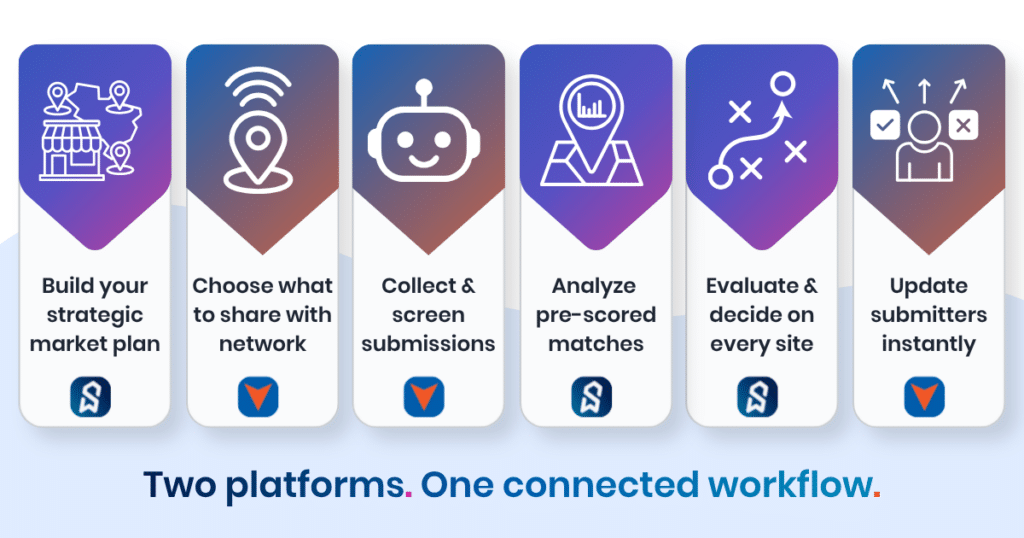
The technology doesn't replace the information advantage he spent years building. It extends it. Rather than relying entirely on his personal network to discover tenant demand, he can see what expanding tenants are looking for and connect those requirements with sites that might fit, allowing the same basic process that once depended on hundreds of individual conversations to happen much more efficiently.
This gets at a larger issue in commercial real estate. For decades, owners and developers have largely been limited by the information contained within their own networks. Tenants know where they want to grow and what types of sites they need, while developers know which properties they control, which sites they're pursuing, and what they could potentially build. Both sides have valuable information, but there has historically been no efficient way to connect it.
That's beginning to change.
When tenant demand can be communicated directly to the market, developers don't have to spend as much time guessing where the next opportunity might come from. A site can be evaluated against actual demand rather than a speculative tenant list, while tenants gain access to properties they may never have encountered through their existing relationships.
For developers, that can change the economics of the entire process. Instead of starting with land and hoping to find a tenant, you can increasingly start with demand and work backward toward the real estate. The more efficiently those two pieces of information meet, the less time good opportunities spend sitting on the sidelines.
I think that's where technology is going to have its biggest impact on commercial real estate. It isn't necessarily about replacing the relationships that make this industry work. It's about extending them beyond the limits of any individual person's network.
The developer I had lunch with already built his information advantage the old-fashioned way. Sytes simply gives that advantage somewhere else to go.
And when demand can find supply faster, good sites have a much better chance of becoming good developments.